WBPSC Clerkship PYQ: Complete Guide to Previous Year Question Papers

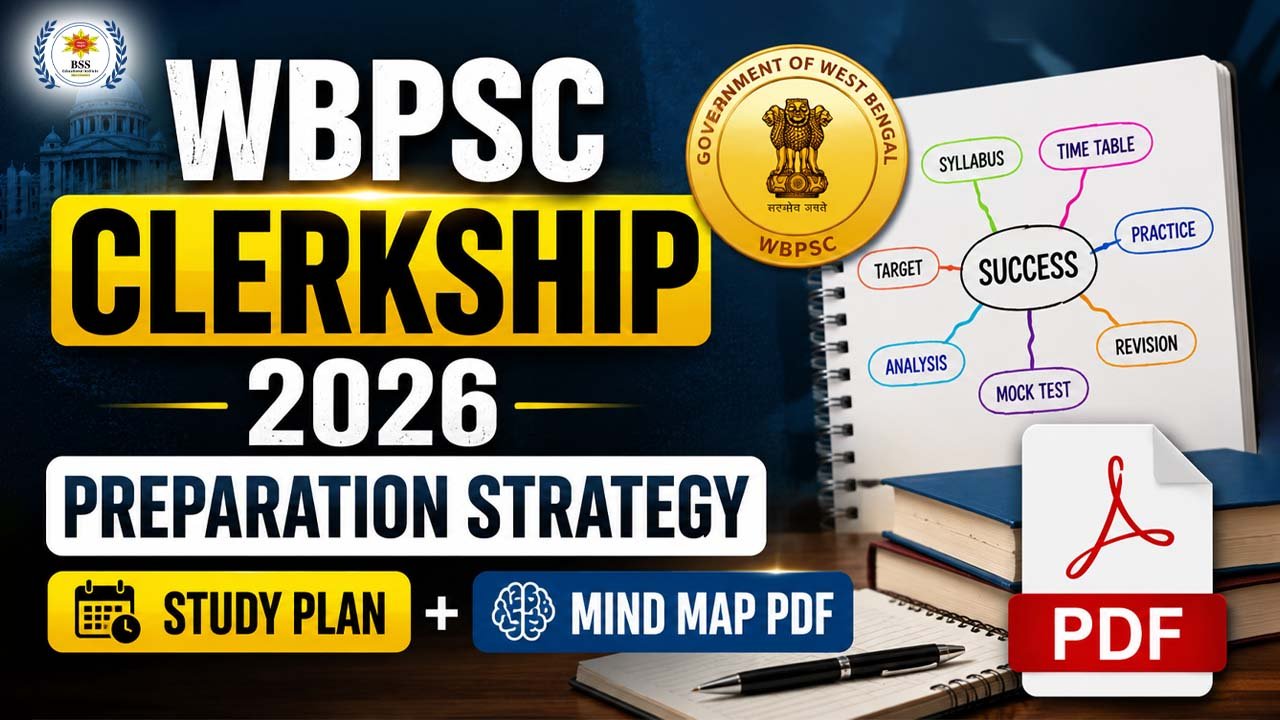
If you’re preparing for the West Bengal Public Service Commission (WBPSC) Clerkship exam, practicing WBPSC Clerkship PYQ (Previous Year Questions) is one of the smartest ways to boost your preparation. This blog covers everything about the WBPSC Clerkship exam, its pattern, syllabus, and how solving WBPSC Clerkship PYQ can help you crack the exam in 2026.
What is the Clerkship Exam?
The WBPSC Clerkship Exam is a state-level competitive examination conducted by the West Bengal Public Service Commission to recruit candidates for clerical posts in various government departments across West Bengal. It is a highly sought-after opportunity for candidates who have passed their Madhyamik (Class 10) examination, as it offers job security, a steady government salary, and long-term career growth. Every year, lakhs of candidates apply for this exam, making it one of the most competitive state-level recruitment exams in West Bengal.
To download the Previous Years Question PDF, click on the download button.
Clerkship Posts
Candidates selected through the WBPSC Clerkship exam are appointed to clerical and administrative posts in various West Bengal government offices and departments. These roles typically involve office administration, documentation, data entry, correspondence, and other clerical duties. The posts come with the benefits of a permanent government job, including pay scale, allowances, and career progression opportunities.
Know More: Download Now The WBPSC Clerkship Full Syllabus And Start Your Preparation!
Exam Pattern
The WBPSC Clerkship exam is conducted in three main stages:
- Part I – Preliminary Exam (Objective Type)
- Part II – Main Exam (Descriptive/Conventional Type)
- Computer Knowledge and Typing Test
Part I (Preliminary Exam):
- Total marks: 100
- Total questions: 100 (Multiple Choice Questions)
- Duration: 1 hour 30 minutes (90 minutes)
- Subjects: English Language, Arithmetic, and General Studies
- Negative marking: 0.25 marks deducted for every wrong answer

Part II (Main Exam):
- Descriptive/written type paper
- Duration: 1 hour (60 minutes)
- Divided into two groups: Group A (English) and Group B (a regional language such as Bengali, Hindi, Urdu, Nepali, or Santali)
After clearing both parts, candidates move to the Computer Knowledge and Typing Test, followed by document verification, before final selection.
Read More: Know About WBPSC Clerkship Full Guide!
Syllabus Overview
The WBPSC Clerkship syllabus for Part I is divided into three main sections:
- English Language: Grammar, vocabulary, comprehension, sentence correction, synonyms-antonyms, and error detection.
- Arithmetic: Basic mathematics including number systems, percentages, ratio and proportion, simple and compound interest, profit and loss, time and work, and data interpretation.
- General Studies: Current affairs (national and international, with a focus on West Bengal), general knowledge, history, geography, polity, and science-based general awareness.
For Part II, candidates need to focus on writing skills such as report writing, précis writing, and translation exercises (English to regional language and vice versa), depending on the chosen Group B language.
Know More: Download WBPSC structured Book List PDF!
Clerkship Previous Years Questions
WBPSC Clerkship PYQ refers to the actual question papers asked in previous years’ Clerkship exams. These papers give you a real sense of the question style, difficulty level, and the topics that are repeatedly tested. Solving WBPSC Clerkship PYQ regularly helps you become familiar with the exact exam pattern used by WBPSC, rather than relying only on generic mock tests.

Why It Is Important to Solve WBPSC Clerkship PYQ
- Understand the real exam pattern: WBPSC Clerkship PYQ shows you exactly how questions are framed, which is often different from standard practice material.
- Identify important and repeated topics: Certain topics from English, Arithmetic, and General Studies tend to repeat across years, and solving PYQs helps you spot these patterns.
- Improve speed and accuracy: Regular practice with WBPSC Clerkship PYQ under timed conditions builds the speed needed to complete 100 questions in 90 minutes.
- Reduce negative marking risk: Since there is a 0.25 mark penalty for wrong answers, practicing PYQs helps you learn which questions to attempt confidently and which to skip.
- Boost confidence: Solving actual past papers reduces exam-day anxiety since you already know what to expect.
- Self-assessment: WBPSC Clerkship PYQ helps you track your preparation level and identify weak areas that need more attention before the 2026 exam.
How to Download WBPSC Clerkship PYQ
You can download WBPSC Clerkship PYQ through the following steps:
- Visit the official WBPSC website (wbpsc.gov.in).
- Look for the “Previous Year Question Papers” or “Exam Papers” section, often listed under Recruitment or Notifications.
- Alternatively, several trusted government exam preparation websites and coaching platforms also compile and offer free WBPSC Clerkship PYQ PDFs, year-wise.
- Select the relevant year’s paper and click on the download link.
- Save the PDF to your device for offline practice.
- Cross-check the answer key along with the question paper, if available, to evaluate your performance accurately.
Always prefer official sources or well-reviewed exam preparation platforms to ensure the PYQs are authentic and free from errors.
Tips to Practice WBPSC Clerkship PYQ
- Set a timer: Always solve WBPSC Clerkship PYQ within the actual exam duration of 90 minutes to build real exam speed.
- Start topic-wise, then move to full papers: Begin by solving PYQ questions section-wise (English, Arithmetic, General Studies), then attempt complete papers closer to the exam.
- Analyze your mistakes: After solving each paper, review incorrect answers carefully and understand why you got them wrong.
- Maintain an error log: Keep a notebook of frequently repeated mistakes and weak topics to revise them regularly.
- Revise General Studies regularly: Since current affairs change often, focus on the last 6-12 months of news, especially related to West Bengal, while solving GS-based PYQs.
- Practice regional language sections: For Part II, dedicate separate practice time to translation and writing skills in your chosen regional language.
- Combine PYQs with mock tests: Use WBPSC Clerkship PYQ alongside mock tests to get a complete practice routine that mirrors the real exam experience.
- Track your progress: Solve PYQs from multiple years and compare your scores over time to measure improvement.
Solving WBPSC Clerkship PYQ consistently is one of the most effective strategies to crack the WBPSC Clerkship exam in 2026. It not only familiarizes you with the exam pattern and syllabus but also sharpens your speed, accuracy, and confidence. Combine PYQ practice with a solid understanding of the syllabus and regular current affairs revision to maximize your chances of success.
FAQs on WBPSC Clerkship PYQ
Q1. What is WBPSC Clerkship PYQ?
WBPSC Clerkship PYQ refers to the previous year question papers of the WBPSC Clerkship exam. These are actual papers asked in past exams, and practicing them helps candidates understand the real exam pattern and difficulty level.
Q2. Where can I download WBPSC Clerkship PYQ for free?
You can download WBPSC Clerkship PYQ from the official WBPSC website (wbpsc.gov.in) under the notifications or previous papers section, or from trusted exam preparation websites that offer year-wise PDFs for free.
Q3. How many years of WBPSC Clerkship PYQ should I solve before the 2026 exam?
Ideally, candidates should solve at least the last 5 to 10 years of WBPSC Clerkship PYQ. This helps identify repeated topics and question trends across multiple years, giving a broader picture of what to expect in 2026.
Q4. Does solving WBPSC Clerkship PYQ guarantee selection?
No single resource can guarantee selection, but solving WBPSC Clerkship PYQ significantly improves your chances by building familiarity with the exam pattern, improving speed and accuracy, and helping you manage negative marking better.
Q5. Is there negative marking in the WBPSC Clerkship exam?
Yes. In Part I of the WBPSC Clerkship exam, 0.25 marks are deducted for every incorrect answer. Practicing WBPSC Clerkship PYQ helps you learn which questions to attempt confidently to avoid unnecessary penalty.
Q6. Which subjects are covered in WBPSC Clerkship PYQ?
WBPSC Clerkship PYQ papers mainly cover English Language, Arithmetic, and General Studies for Part I. Part II PYQs focus on descriptive writing, including English and a regional language such as Bengali, Hindi, Urdu, Nepali, or Santali.
Q7. Can WBPSC Clerkship PYQ help with Part II (Main Exam) preparation?
Yes, though Part II is descriptive, previous year papers can still help you understand the type of essays, reports, précis, and translation questions typically asked, so you can practice writing accordingly.
Q8. Is it better to solve WBPSC Clerkship PYQ or mock tests?
Both are useful. WBPSC Clerkship PYQ gives you the exact real exam experience and question style, while mock tests help you practice with fresh questions on similar topics. Using both together gives the most complete preparation.
Q9. How should I use WBPSC Clerkship PYQ in my daily study routine?
Set aside a fixed time daily or weekly to solve one full WBPSC Clerkship PYQ paper under timed conditions, then spend time reviewing your mistakes and revising weak topics before moving to the next paper.
Q10. Are answer keys available along with WBPSC Clerkship PYQ?
Many official and third-party sources provide answer keys alongside WBPSC Clerkship PYQ, which is useful for self-evaluation. Always cross-check answers from a reliable source to ensure accuracy.


Upcoming Competitive Exams
WBPSC Assistant Teacher Syllabus…
The WBPSC Assistant Teacher Syllabus 2026 is the most important...
October 13, 2026
WBPSC Clerkship New Notification…
The Public Service Commission, West Bengal (WBPSC) has published the...
October 6, 2026
WBPSC School SI Syllabus…
The School SI Syllabus is the first thing every aspirant...
October 2, 2026
WBPSC Miscellaneous Admit Card…
The West Bengal Public Service Commission (WBPSC) has officially released...
September 23, 2026
IBPS Clerk Recruitment 2026:…
The Institute of Banking Personnel Selection (IBPS) conducts the IBPS...
July 28, 2026

Form Fill-up Going On

Recent Posts
Categories
- West Bengal Police
- SSC
- WB SSC
- SSC SLST
- Kolkata Police
- WBPSC
- Teaching Exams
- Teaching Job
- Gram Panchayat
- JSSC Notes
- Central Govt. Exams
- Railway
- Government Job
- Gram Panchayat
- Armed Forces/Police
- SSC
- Private Job
- WBPSC
- Current Affairs
- Daily
- Teaching Exams
- News
- Banking
- Job Updates
- Weekly
- Central Govt. Exams
- IBPS PO
- Notes & Materials
- WB Govt. Exam
- Books
- IBPS Clerk
- Upcoming Competitive Exams
- WB Govt Exams
- UGC NET
- WBPSC Teacher
- Form Fill-up Going On
- WBPSC
- SSC SLST
- UGC NET
- EMRS
- WB TET
- SBI PO
- WB TET
- BPSC
- Jharkhand TET
- PHD Notification
- RBI
- Jharkhand TET
- CTET
- Other Updates
- CTET
- BPSC
- Knowledge Bulletin
- SSC GD
- KVS
- Nursing
- RPF
- Railway
- SBI
Connect with Us


